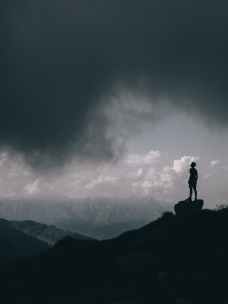
Loneliness is an aspect of the human condition that has long shadowed consciousness. The duality, or indeed, multiplicity inherent in the thinking mind has created a divide for many, between what we show to the world and what we keep hidden. For some, building a bridge across this divide is a life’s work to which they are happy to dedicate themselves. A sound bridge means we can trot from one place to the next without too much overlap. Just as we strengthen neuron pathways when we use them repeatedly, separating our private and public selves can strengthen this divide. But coming home to the castle and winding up the drawbridge can be lonely. Can that bridge ever remain stable and at what cost? How to meet the needs of both the deep self, or ‘I’ of consciousness and the activated self, or rather selves, needed for use within the caper of human life?
For some, it may be a clear case of choosing a side and forget the bridge. Social world or solitary world? Those whose minds are located mostly in the solitary or internal spaces, can get by with a handful of rote pleasantries, and some basic interactive tools. The peace afforded by time alone, can be centring and thus, a trip to town for some banking and a hair cut, is just enough to feel part of things. The socially activated can stay social all day and all night at the flick and scroll of the device, never needing to feel alone for a moment.
For some, once the place that feels like home is decided, it seems best to stay there, as trying to live in both will only create discord. Doubt. Inexplicable sadness. And the complete lack of a map with which to go forward. But for most of us, it is balance we are seeking. A way to bob along with the ebb and flow of both worlds, while remaining whole throughout. The middle path. The Taoist way.
In Plato’s Symposium, a creative recount of a gathering of men who essentially eat, drink, dance and philosophise, Aristophanes discusses the concept of humans as broken cartwheels, once whole, now divided, eternally looking for their other half. Centuries of philosophers have debated how we might appease this sense of longing for reconnection with self. Descartes famously pondered the mind body relationship dualistically, essentially encouraging the idea of an internal divide within each individual, while Nietzsche appeared to find the weighty experience of his own advanced intellect profoundly alienated him from his social world, thus creating a unavoidable separation, and who knows, yes, probably loneliness. Once we reach the 20th century, post-modernism makes it damned hard to keep believing that someone up there in the cosmos actually planned it all this way, and the search for meaning and wholeness becomes even more gritty.
But what of the 21st Century divide? When all has been said and done, and it has , have we come any further with things? Are we more or less lonely? For some, love is the antidote, a form of spiritual sanctuary wherein existential angst is soothed by finding emotional connection with another person. But a good deal of spiritual practices, both traditional and contemporary, centre around finding connection instead with the self. How are we going with that?
Post Covid statistics on loneliness tell a more recent story, with isolation periods and activity pauses triggering something that was waiting to be triggered. For some who did not experience devastation and loss this period became a blessing, delivering just what they had been wanting but didn’t know it; an excuse to disconnect. Introverts rejoice!
And like so many social mores that have been challenged and found wanting, commitments to social interaction (albeit at times a chore) as acts civilised behaviour became another thing we could opt out of. All manner of human intimacies under review. Neighbours are just people who live next door. Teachers, a glitchy face online. Recalcitrant youths were no longer required to visit their grandparents.
And yet, Google it and some kind of unsubstantiated source will tell you..
“Researchers have found that loneliness is just as lethal as smoking 15 cigarettes per day. Lonely people are 50 percent more likely to die prematurely than those with healthy social relationships. ”
So what exactly are people doing with their loneliness? Once we have reached a point where we are staring at the Netflix menu from within a bubble of mind bending alienation and utter emptiness unable to stomach another moment of it , what are we doing next?
Is a dusty favourite book being dragged from a packing box, and if not read, (because loneliness can be quite draining and jumping into Dosteovsky may not actually be psychologically possible.)..but holding it, and turning it over, and flicking to a page in the middle and reading that.. maybe.
Are old records played? If not records, Cd’s perhaps… anything other than Spotify? Is the telephone used as a talking device to have a long conversation, where communication filters down around tone of voice and pauses, revisiting the need to articulate clearly, maybe more than once, and even recap a story entirely, after the accidental plummeting of the phone to the floor, or the need for one or the other to pee. Are diaries scribbled in, the same childhood doodles scratched out, night skies simply gazed at, guitars tuned too slowly and strummed with lacklustre, lines of poetry awkwardly obliged …
I’m not a loneliness expert. I’ve been in and out of it in my life. And I’m aware it is a defining experience in our world now. But ultimately loneliness is so very personal, and means different things to different people. For some loneliness threatens status. Reputation. Self-esteem. Neediness is a sign of failure. Let’s face it, when someone asks us how we are, we are hardly going to say..”.Uhh, really just awfully gut wrenchingly lonely actually. ” Being an introvert, well understood. Being a hermit, off grid -very cool. But being lonely.. feels desperate, deficient and unappealing.
I admit I am at times an introverted, over-thinking, hypersensitive, melancholic type. I have had moments where the sheer weight of my aloneness just silences all other thought. I actively counter this with love. I foster love the moment loneliness creeps in, with whatever is to hand. Cuddle the dog, talk to a pot plant. I thrive on loving interactions with the world and have always surrounded myself with them. The cooking, the dancing, the singing, the art making, the colourful clothes, the clumsy humour, the persistent attempts at courage, the utter devotion to things I value, all is for love.
Loneliness then for me, is not being alone, but a place where I can’t give love. Where doors to that natural instinct have been closed or remain unsafe to open. A relationship that has wounded my pride. Or a workplace, where kindness and open-heartedness are just not in the job description. It is in these spaces that I feel most alone. Not giving love, is like trying to hold the tide back. Its exhausting.
I visualise these fantastical activity programs to tend loneliness all the time. Creative applications, for care and therapy. In the absence of elders and oracles, wise woman and sages, the need for lonely individuals to find something to love could be much better understood. And in the spaces between the busy love making activities of life, the cooking, the singing, the dancing, there might be less aggravated loneliness and more just sitting…quietly ..at peace.


 The Palimpsest